Don't Buy the 3000 Series Dual Basket Na350 00 Until You Read This Full Analysis
Introduction to the Modern Kitchen Landscape
The evolution of kitchen appliances over the last decade has been nothing short of a revolution. From the rise of the instant pressure cooker to the ubiquity of the air fryer, homeowners are increasingly looking for ways to streamline their meal preparation without sacrificing health or flavor. Among the most competitive segments in this market is the multi-basket air fryer category. The 3000 Series Dual Basket Na350 00 has recently emerged as a significant contender in this space, promising a blend of high-capacity cooking and versatile multi-tasking capabilities. However, as with any major appliance purchase, it is essential to look beyond the marketing slogans and investigate how the machine actually performs in a high-pressure, daily-use environment.
For many households, the primary challenge of weeknight cooking is synchronization. Preparing a main protein and a side dish often requires juggling multiple appliances or timing oven racks perfectly. Dual-basket technology aims to solve this by providing two independent cooking zones. The Na350 00 enters a crowded field inhabited by established brands, but it manages to differentiate itself through a focus on specific ergonomic choices and heating efficiency. This analysis will break down whether this model represents a true leap forward or if it is simply another iteration of a familiar concept.
Detailed Product Analysis and Design Architecture
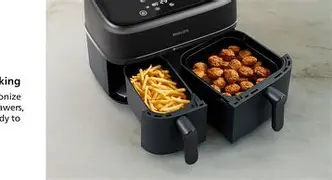
The core philosophy behind the 3000 Series Dual Basket Na350 00 is "divided efficiency." On the surface, the unit features a sleek, matte-finish exterior that aligns with contemporary kitchen aesthetics. But the real engineering happens inside the drawers. Each basket is designed with a proprietary air circulation pattern intended to minimize "cold spots," a common grievance among users of larger-capacity fryers. While many dual fryers suffer from power drop-off when both zones are active simultaneously, the internal power distribution system of the Na350 00 is calibrated to maintain consistent wattage across both heating elements.
The interface is a touch-capacitive LED display that remains dark until the unit is powered on, creating a clean look on the countertop. It offers several pre-programmed modes, but the most critical feature for serious cooks is the manual override. The ability to fine-tune temperature in 5-degree increments and time in 1-minute increments allows for the precision required for delicate tasks like dehydrating herbs or roasting coffee beans, alongside standard high-heat tasks like crisping wings or roasting potatoes. The "Sync" function is perhaps its most vital software component, ensuring that two different foods with two different cooking times finish at exactly the same moment.
Thermal Performance and Airflow Dynamics
Unlike standard convection ovens, which rely on large-scale air movement, the Na350 00 utilizes high-velocity "Rapid Circulation" technology. By housing the heating element directly above a high-speed fan, the unit creates a localized vortex of heat. In the 3000 Series, this airflow has been optimized to penetrate the center of the basket more effectively. Buyers often find that in dual-basket models, the food closest to the divider wall can undercook compared to the outer edges. The Na350 00 addresses this through asymmetrical venting in the basket base, which pushes more hot air toward the center of the machine to compensate for the shared wall's thermal properties.
Usability and Ergonomics
The weight of the baskets is a frequently overlooked factor. When a basket is loaded with three pounds of chicken, the handle integrity and the ease of the sliding mechanism become paramount. The 3000 Series features reinforced handles with a "Cool-Touch" coating that remains safe even after an hour of 400-degree operation. The baskets slide into the chassis with a tactile click, providing secondary confirmation that the safety sensors are engaged and the cooking cycle can begin. This focus on physical feedback reduces the likelihood of "operator error" where a cycle fails to start because a drawer is a millimeter out of place.
Real-World Use Cases: Testing the Limits
To understand the value of the Na350 00, it is helpful to look at common scenarios where a single-basket fryer usually fails. Consider the "Sunday Roast" scenario. In a traditional air fryer, a cook would have to roast a whole chicken first, then keep it warm while roasting vegetables, often resulting in soggy skin on the bird. With the dual-basket setup, the chicken can occupy the left zone at a lower temperature for a longer duration, while the right zone handles root vegetables at a higher heat for a shorter duration. The synchronization feature handles the math, delaying the start of the vegetables so everything hits the plate piping hot.
Shop the latest Electronics picks on Amazon.
Shop Amazon →Another common use case is dietary separation. In households where one member follows a gluten-free or vegetarian diet, the dual baskets act as a physical barrier against cross-contamination. You can fry breaded mozzarella sticks in one side while keeping the other side purely for un-breaded vegetables or specialized proteins. This level of utility makes the 3000 Series a lifestyle tool rather than just a cooking gadget.
Pros and Cons Analysis
Every appliance represents a series of trade-offs. While the 3000 Series Dual Basket Na350 00 excels in many areas, there are specific limitations that potential buyers should weigh against their specific kitchen needs.
- Pro: Dual-Zone Versatility — The ability to cook two entirely different types of food simultaneously is the primary selling point …
Feature 3000 Series Na350 00 Industry Standard (Average) Total Capacity 9.0 - 9.5 Quarts Total 8.0 Quarts Temperature Range 100°F - 450°F 150°F - 400°F Sync-Finish Tech Included (Smart Logic) Varies by model Basket Material Reinforced Aluminum / Non-Stick Coated Steel Pre-set Programs 8 Optimized Modes 6 Standard Modes Comprehensive Buying Guide: Is This Model Right for You?
Before committing to the 3000 Series Dual Basket Na350 00, it is important to evaluate several internal factors within your own household. Not every kitchen requires the complexity of a dual-basket system, and for some, the added size may be a hindrance rather than a help.
Assess Your Cooking Volume
The Na350 00 is designed for families of three to five people. If you are cooking for one, you may find the dual-basket setup cumbersome, as the individual baskets are smaller than a single-zone XXL fryer. However, if you regularly prepare multi-component meals, the divided capacity is a massive boon. It is also important to measure your cabinet clearance. While the footprint is tight, the unit needs at least 5 inches of rear clearance for proper hot air exhaustion.
Consider Your Dietary Needs
As mentioned previously, the ability to separate ingredients is a game-changer for Mixed-dietary households. If you are constantly washing a single basket between cooking meat and vegetables, the efficiency gains of the Na350 00 will be felt immediately. Furthermore, the low-temperature range (down to 100°F) makes this an excellent choice for those interested in food preservation, such as drying fruits or making jerky, which is often not possible on cheaper models that bottom out at 200°F.
Discover deals on Electronics — updated daily.
See Deals →Longevity and Quality of Construction
In the electronics world, "plastic fatigue" is a real concern for appliances that endure high heat cycles. The 3000 Series uses high-impact, heat-resistant polymers that are designed to resist warping. When evaluating this model, look at the hinge points and the basket tracks. The Na350 00 uses a thicker gauge of metal for its internal supports than entry-level models, which suggests a longer lifespan for the mechanical parts of the machine. For a frequent user who plans to use the air fryer 4-5 times a week, this durability justifies a slightly higher initial investment.
Advanced Features and Internal Logic
One of the more nuanced aspects of the Na350 00 is its internal "Match Cook" software. While "Sync" is for different foods, "Match" is for cooking a double batch of the same food. If you are hosting a gathering and need to cook five pounds of potatoes, Match Cook allows you to set the parameters for one basket and instantly copy them to the second. This prevents the inconsistency that often happens when a user tries to manually replicate settings across two different digital controllers.
The sensor array inside the machine also deserves mention. It monitors the ambient temperature of the kitchen and the internal cavity to adjust fan speeds dynamically. If the unit detects that the internal temperature is rising too quickly (perhaps due to high fat content in the food creating an oil mist), it will modulate the heating element to prevent smoking. This is a crucial safety feature that protects both the appliance and the air quality of the home.
Conclusion: The Final Verdict on the Na350 00
The 3000 Series Dual Basket Na350 00 represents a sophisticated approach to modern air frying. It is not merely a box with a heater; it is a thoughtfully designed culinary tool that prioritizes the logistics of actual meal preparation. The combination of high-precision temperature control, intelligent synchronization, and robust physical construction places it in the upper echelon of the mid-to-high-range kitchen electronics market.
While the noise levels and the power requirements are minor drawbacks, they are outweighed by the sheer utility of the dual-zone system. For the buyer who is tired of of the "staggered start" shuffle of traditional cooking, or for the family that needs to cater to diverse dietary requirements simultaneously, the Na350 00 offers a compelling solution. It streamlines the cooking process without the bulk of a full-sized convection oven, making it a worthy centerpiece for the health-conscious, time-constrained kitchen.